
The Wrong Page
Seeing the Same Thing from Different Places
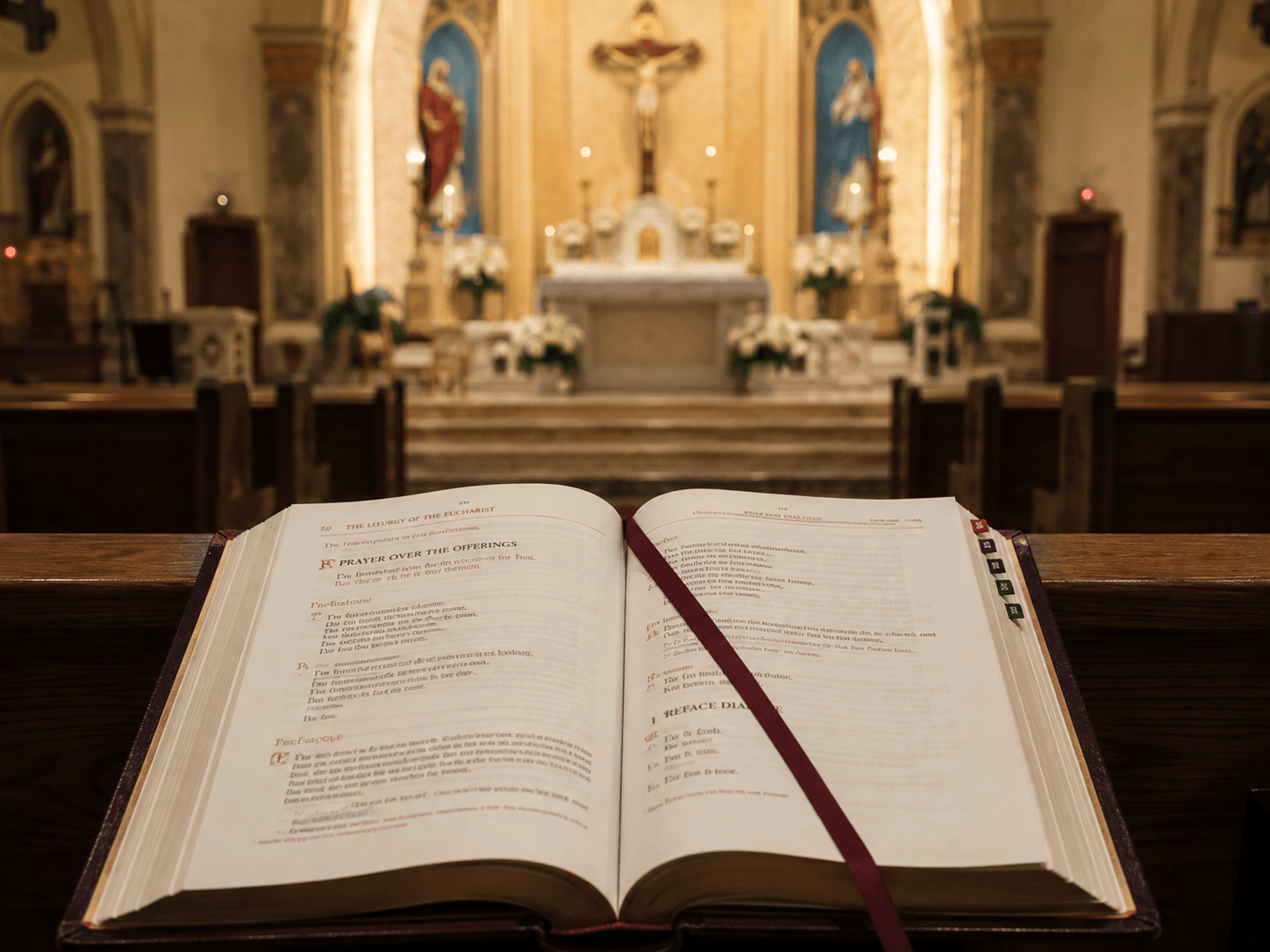
Sometimes the wrong page still leads us back to the right order.
Last Sunday, we attended Mass at a church other than our usual parish. I picked up an unfamiliar missal in the pew and opened it to the readings for that week. I began reading the Gospel, which started with the words, “No one can serve two masters.” (Matthew 6:24)
I thought I had heard that Gospel recently, but I waved the thought away. Maybe it had been longer than I remembered. The passage is usually connected with money and the things of this world, but that morning my thoughts went to work and a recent disagreement with my boss.
We had not been on the same page about how something should be handled. I was thinking about the larger process and how one decision might affect several other things later. He was focused on a smaller detail that needed his attention at that moment.
That is often how I look at things. I tend to see how all the pieces connect, but that does not mean my view is always correct. My responsibility was to explain what I saw as clearly as I could. His responsibility was to make the final decision, and once he did, I still had a responsibility to respect his position and do the work the way he had chosen.
Reading that no one can serve two masters made me think about where that kind of authority begins and ends.
Having a boss does not mean having another master in the way Jesus meant it. A boss has rightful authority within the workplace. He can decide what needs to be done, establish priorities, correct mistakes, and choose a different approach from the one I recommended.
That is part of working for someone else. I am expected to do my job honestly, respect his position, and follow the decision once it has been made, even when I would have chosen another direction.
Being a Christian should not make me less willing to do those things. Putting God first should make me more dependable, more honest, and more willing to admit that I may not have seen everything correctly.
At the same time, there is a difference between serving someone and allowing that person to control everything happening inside me. My boss may direct my work, but he should not determine my worth or become the voice I fear disappointing more than I fear disappointing God.
I could respect my boss and still disagree with him. I could explain the larger picture as I saw it and still accept that the final decision belonged to him. I could follow his direction without pretending that I had changed my mind.
The question was what I did after the conversation ended. Could I accept the decision and move forward, or would I keep replaying the disagreement for the rest of the day?
As I thought about that, I remembered something my son had brought home from camp a couple of weeks earlier. This year’s theme was Deus Primus, which means God first.
The camp lasted a week, and much of its focus was Saint Thomas More. My son told me about this other Thomas who had served the king but would not place the king above God.
I have always felt connected to Saint Thomas the Apostle. Now my son had given me a reason to think more about another saint who shared our name.
Saint Thomas More served King Henry VIII as Lord Chancellor. He took his work seriously and was trusted with an important position. He was not someone who rejected authority whenever he disagreed with it. He served his king and his country faithfully for many years.
Eventually, the king demanded something Thomas More could not accept without going against his faith and conscience. At that point, he had to decide which authority came first.
He is remembered for saying, “I die the King’s good servant and God’s first.”
Saint Thomas More still called himself the king’s good servant. He did not pretend his years of service had meant nothing. He understood that he could serve an earthly authority honestly and faithfully without giving that authority the place that belonged to God.
The king had authority over his public office, but God had authority over his life. That fit perfectly with what my son had learned at camp.
Deus Primus. God first.
I can be a good employee and still belong first to God. I can follow directions, respect my boss, and carry out a decision even when I think another choice would have been better.
Putting God first does not mean that every disagreement becomes a matter of conscience. Most workplace disagreements are simply two people looking at the same problem from different places. One may be focused on the immediate detail while the other is considering the larger process, and either person may be missing something.
Sometimes serving well means speaking honestly about what I see. Sometimes it means listening to what I may have missed. Sometimes it means doing the work the way my boss has chosen and allowing the results to show whether the decision worked.
There are also limits. If I were asked to be dishonest, act against my faith, or violate my conscience, then my loyalty would need to be clear. God comes first.
There are quieter ways of forgetting that order too. I may never be asked to do something seriously wrong, but I can still allow a disagreement at work to take over my thoughts. I can bring it home with me, become impatient with my family, and spend the evening arguing with my boss in a conversation that exists only in my head.
When that happens, I have allowed the disagreement to take up more of my life than it should.
I was still thinking through all of this when my wife leaned toward me and quietly said, “You’re on the wrong readings.”
I looked down at the missal and realized she was right. I had opened to the Eighth Sunday in Ordinary Time, but we were celebrating the Eighteenth Sunday. I was ten weeks off.
I laughed quietly, turned to the correct readings, and continued preparing for Mass. After spending all that time thinking about how my boss and I were not on the same page, I discovered that I was literally on the wrong page.
The mistake did not make everything I had been thinking correct. It did not mean God had directed me to the wrong reading or that my side of the disagreement at work had been proven right. It simply gave me something worth considering.
Maybe being on the wrong page is not always about which person sees the larger picture or which person has the better solution. Sometimes it means recognizing that we are looking from different places and that neither of us may be seeing the whole thing.
Saint Thomas More showed that being God’s servant first does not prevent us from being good servants to others. It teaches us how to serve them properly. We can respect authority without giving it the place that belongs to God. We can disagree without becoming disrespectful. We can follow directions without allowing another person’s opinion to define us.
My wife helped me find the right page in the missal that morning. My son’s camp lesson helped me remember the right order.
Deus Primus. God first.
