
Known Beyond the Records
When There are no more Leaves on the Branches
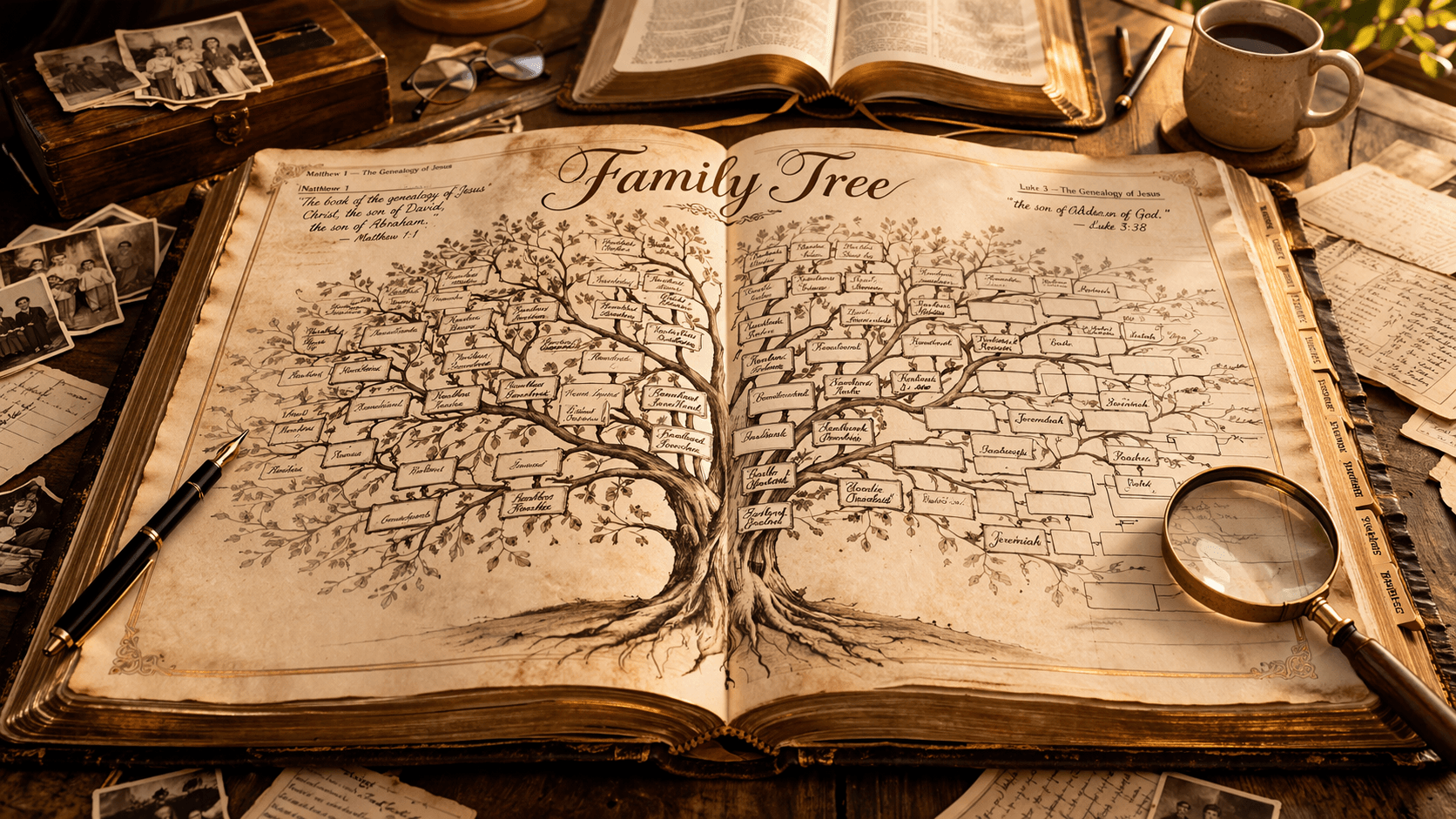
A quiet story of roots, names, and the lives that came before us.
The other day I met someone who asked me if I was related to another person who shares my last name. It is one of those questions I get from time to time, and I knew the answer right away. No, I am not, at least not in the way they meant it. But that simple question got me thinking. It sent me right back to my family tree, back to the names and dates and little leaf hints, back to the branches I keep trying to push just a little farther.
At first, looking through a family tree can feel pretty exciting. You start seeing names you know. My mom’s side. My dad’s side. Grandparents. Great Grandparents. A few lines go back six or seven generations, and for a little while it feels like the road is clear. Then it happens again. The line just stops. No more records. No more names. Maybe a guess. Maybe a census entry that almost fits. Maybe a spelling change that sends you down the wrong trail. Then nothing. It is like following an old country road that starts out paved, then turns to gravel, then dirt, then grass, until you are not even sure if it was still a road at all.
That is what makes genealogy so interesting to me. I am not only looking for names to plug into a chart. I am trying to understand where I come from, who I share a name with, and even the kind of names we hand on to children and grandchildren. I am trying to picture the people whose lives, choices, work, faith, and struggles eventually led to mine. I think that is why family history grabs people the way it does. It is not just curiosity. It is the desire to know that your life is connected to something before you, that your story did not start the day you were born.
That is also why my wife’s side of the family tree is so hard to follow. Her Filipino roots are beautiful, but tracing them gets tricky in places, and there is a reason for that. The Clavería decree brought order to surnames in the Philippines, but it also made a mess of family lines on paper. Spanish last names were assigned for recordkeeping, not always because they matched the deeper family line. So, cousins could end up with totally different last names, not because they were not family, but because the record was organized in a way that did not keep the full story together. A surname might look official, but that does not always tell the whole truth.
There is something real in that. A person can look at a last name and assume they understand where a family comes from, when sometimes they only understand what got written down. The paper says one thing. The blood says another. The family remembers something else. The heart still wants to know what is true.
That hits home for me too, just in a different way. I know this much. Just because my last name does not line up neatly with every part of my family line the way people expect, that does not change where I come from. It does not change the people who loved me, raised me, and shaped me. It does not change the line that means something to me. My signature on paperwork may say one thing, but the story of who formed me runs deeper than that.
Maybe that is why people still care so much about lineage. Back then, in biblical times, it mattered a lot. People cared whose son you were, what house you came from, what tribe you belonged to, and where your family fit in the story of God’s people. In some ways we still do the same thing now. We may not talk about tribes much, but when dating gets serious and marriage comes into view, people still start asking questions. Who are your people. Where do you come from. Are we related. We still care about the line because family still matters.
That is what makes the opening of the Gospels so interesting. Matthew starts tracing the ancestry of Jesus from Abraham through David and Jesse and all the generations that follow until he arrives at Joseph and Mary. Luke keeps going and takes it all the way back to Adam. It is almost like one long parade of begat, begat, begat until Jesus steps into the story. It may sound dry when you first read it, but it tells us something important. Jesus entered the world through a real human family, through real people, through names that were remembered and handed down.
And even there, Scripture does not give us some perfectly polished family record. Those names are not all simple or spotless. Some carried faith. Some carried scandal. Some were remembered with honor. Some barely get more than a mention. And still, God moved through all of them. His providence did not depend on a neat family chart.
That is where my mind landed in all of this. If our deepest identity depends only on what we can trace, then a lot of people are going to feel lost. Some families have cleaner records than others. Some can go back for generations. Some hit a wall after just a handful of names. Some surnames stayed close to the family line. Some got assigned, changed, forgotten, combined, or misunderstood. Even now, with all the books, census records, government forms, websites, and DNA tests, there are still gaps. There are still people we cannot quite find.
But God does not know us the way archives know us.
He does not know us only by surnames and documents and census lines. He does not lose track of us when the branch disappears from the chart. He does not need a perfect record to know who belongs to Him. The Lord says in Isaiah, “Do not fear, for I have redeemed you; I have called you by name: you are mine.”
I love that line.
God does not say, “I know your paperwork.” He says, “I have called you by name.”
That is deeper than a record. That is more solid than a surname. That is more personal than anything written in a courthouse, on a census page, or in a family tree.
I think that is part of what gives me peace when I look at the genealogy of Jesus and then look back at my own family tree. I may never find every missing name. I may never untangle every branch. I may never fully understand all the lines that led to me. But that does not mean the people are lost to God. He knows the grandmother whose name was written down wrong. He knows the cousin whose surname no longer matches the rest of the family. He knows the father, the mother, the child, the whole line, even where history got messy.
And maybe that is part of why people search in the first place. Under all the names and dates is a simple desire. We want to know that we are not random. We want to know that we belong. We want to know that our life fits somewhere.
The Gospel answers that in a way no genealogy website ever can. My truest identity is not finally in a surname, a chart, or a line I can prove. It is that I am a ‘Child of God.’
That is true for me. That is true for my wife. That is true for the branches I can follow and the ones I cannot. Even in Jesus’ day there was a census. Names were recorded. Families were counted. People were listed by town and household. But long before anyone was counted by Caesar, they were already known by God. Before there was a census, He knew us. Before a last name was assigned, changed, recorded, or lost, He knew us.
So, I will probably keep looking. I will still click the hints, follow the branches, and wonder about the people who came before me. I will still care about where I come from, because family matters and history matters. But I think the next time someone asks me if I am related to a person just because we share a last name, I may smile a little differently.
Because no matter what your name is, no matter who you are recorded as, no matter what someone else assumes about your line, you are not forgotten.
You are known.
You are loved.
You are a child of God.
