
A Name We Still Say
Why is he in the Creed?
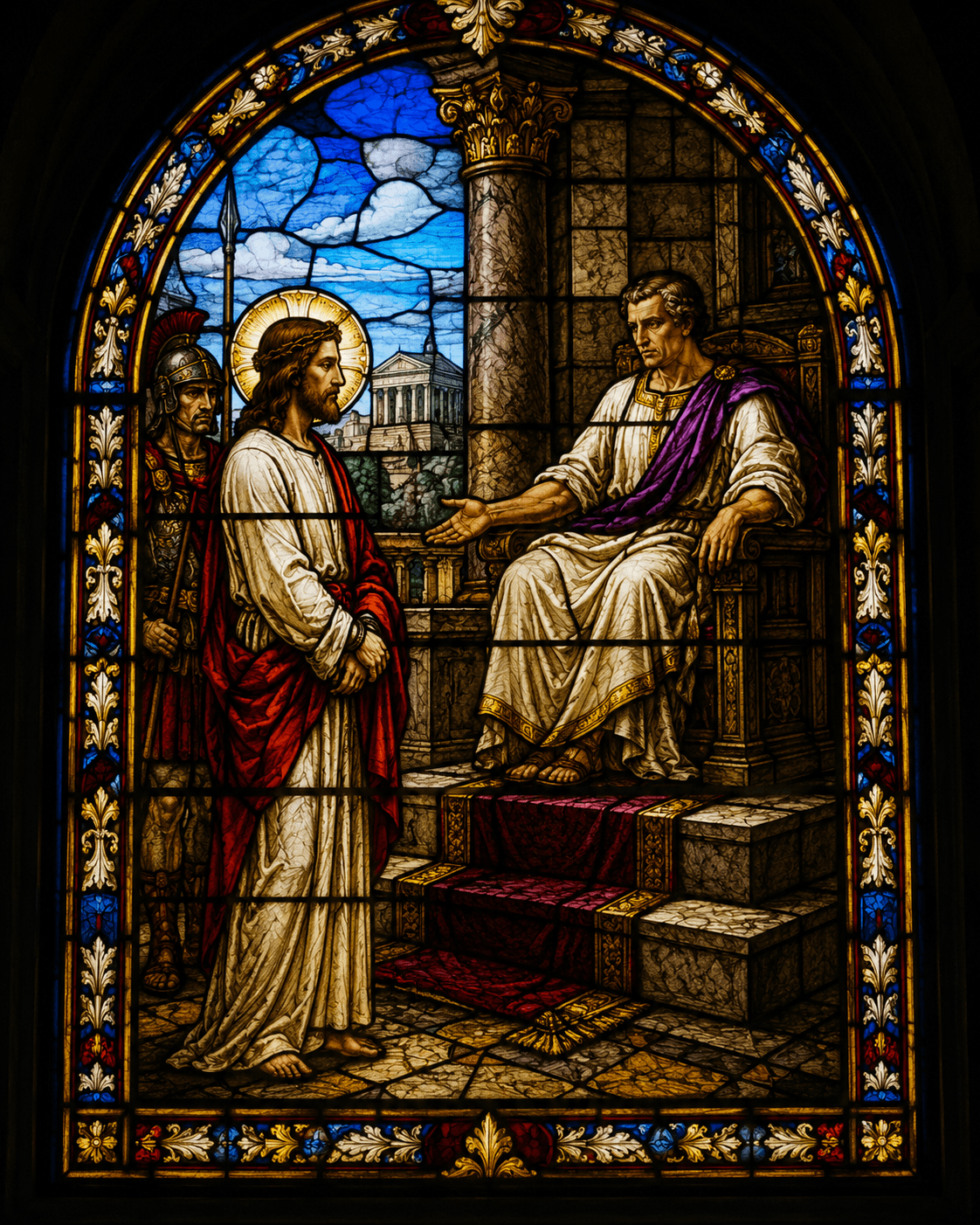
Jesus stood before Pilate as Truth entering real history for our salvation.
Have you ever said the Creed and wondered why we still say Pontius Pilate’s name?
I had that thought one morning while praying the Rosary.
He suffered under Pontius Pilate.
For some reason, I started wondering why his name is still there. Why Pilate? Why is he the one we keep saying out loud all these years later? There was Tiberius Caesar, Herod, Caiaphas, Annas, Nicodemus, Joseph of Arimathea, and plenty of others connected to the time of Jesus. Some were rulers. Some were religious leaders. Some were close to the events of His Passion. So why does the Creed keep naming this Roman governor?
So, I took some time to look it up. And the more I read, the more I realized Pilate’s name is not there by accident. It is not there to honor him. It is there to tell us something important about Jesus.
At first, it feels strange. We understand why we say the names of the Father, the Son, and the Holy Spirit. We understand why Mary is named. She is the Mother of God. Through her yes, Jesus truly entered the world as man. Her name belongs there because the Incarnation is real.
But Pontius Pilate?
He was not a saint. He was not a disciple. He was not someone who followed Jesus with faith. He was not even someone who had a change of heart and gave up everything to follow Christ. He was the Roman governor who questioned Jesus, found no guilt in Him, and still handed Him over to be crucified.
So why do we keep saying his name?
The simplest answer is this. Pilate anchors the Passion of Jesus in history.
When we say Jesus suffered under Pontius Pilate, we are saying that this did not happen in some vague spiritual place. This was not a myth. This was not a legend passed down to teach a nice lesson. This happened in the real world, under a real governor, in a real court, with real soldiers, real wood, real nails, real suffering, and a real death.
Our faith is not built on an idea. It is built on a Person. Jesus Christ entered human history. He was born of the Virgin Mary. He walked on dusty roads. He ate with sinners. He healed the sick. He stood before human authority. He was judged by men who did not understand Him. He was crucified. He died. He was buried. And on the third day, He rose again.
Pilate’s name is like a pin dropped on a map. It fixes the Passion in a place and time. It reminds us that the Son of God did not save us from a distance. He stepped into the middle of our world, with all its politics, fear, weakness, injustice, and sin.
That is one reason the Creed is so powerful. It does not let Jesus become only a comforting thought. It keeps Him concrete. Born. Suffered. Crucified. Died. Buried. Risen.
Those are not vague words. They are real events.
I also started thinking about why Pilate, and not someone else. Why not name Caesar? Why not Herod? Why not Caiaphas? They were all part of the world Jesus lived in. They all had some connection to what happened.
But Pilate was the one who represented Roman authority at the moment Jesus was condemned to death. He was the one who questioned Him. He was the one who had the power to release Him. And he was the one who allowed an innocent man to be crucified.
That makes his name uncomfortable, but maybe that is part of the point. Pilate reminds us what human power can do when it is separated from truth. He shows us what happens when a person knows what is right but chooses what is easier. He finds no guilt in Jesus, but still gives Him over.
Matthew tells us, “When Pilate saw that he was not succeeding at all, but that a riot was breaking out instead, he took water and washed his hands in the sight of the crowd, saying, ‘I am innocent of this man’s blood. Look to it yourselves.’” (Matthew 27:24)
That line is painful because it feels so human. Pilate tries to wash his hands of something he still permits. He wants to be free of the guilt without having to make the hard choice.
And that is where this stopped being only a history question for me.
Because I can look at Pilate and think, how could he do that? How could he stand in front of Truth Himself and still choose fear, pressure, and convenience?
How many times have I known the right thing and still chosen the easier thing? How many times have I stayed quiet when I should have spoken with love? How many times have I washed my hands in small ways, pretending something was not my responsibility because dealing with it would cost me something?
Pilate’s name does not only point backward. It also holds up a mirror.
Not because I am Pilate in some dramatic way, but because the same weakness can live in me. The fear of what others will think. The desire to keep peace at any cost. The temptation to avoid responsibility. The habit of choosing comfort over courage.
That is what sin does. It makes us smaller. It teaches us to protect ourselves, even when truth is standing right in front of us.
Jesus does the opposite. He stands there silent, innocent, and surrendered. He does not manipulate the crowd. He does not beg Pilate for mercy. He does not use power the way the world uses power. He gives Himself completely.
That is the difference between worldly power and divine love. Pilate tries to save himself. Jesus gives Himself to save us.
I once heard a saying that a person dies twice. Once when they stop breathing, and a second time when their name is spoken for the last time. I do not know where that saying truly began. It gets passed around in different forms.
In a strange way, the Creed has kept his name alive for centuries. Every Sunday, and in countless Rosaries, Catholics all over the world say his name. But not because Pilate was great. Not because he was holy. Not because we admire him. His name is remembered because of the One who stood before him.
So, every time we say Pontius Pilate’s name in the Creed, we are not honoring Pilate. We are remembering the truth of what Jesus entered. We are remembering that our salvation came through a real Passion, in a real moment, under real human authority.
And maybe we are also being reminded that Jesus entered the kind of world we still live in.
A world where innocent people suffer. A world where truth gets ignored. A world where people in power sometimes choose what protects them instead of what is right. A world where fear can shout louder than conscience.
Jesus entered that world. He still enters our homes, our workplaces, our parishes, our arguments, our fears, and our hidden places where we would rather wash our hands than face the truth. He does not come to condemn us. He comes to save us. But He also comes to teach us how to stand with Him.
Pontius Pilate is not there because he is worthy of remembrance. He is there because Jesus is. His name marks the moment when human injustice met divine mercy, when cowardice met courage, when sin met the Lamb of God.
Mary’s name reminds us that Jesus truly became man.
Pilate’s name reminds us that Jesus truly suffered and died.
And because both are true, the Resurrection is not just a nice ending to a religious story. It is the victory of God inside real human history.
So, the next time you pray the Creed, slow down when you reach that line.
He suffered under Pontius Pilate.
Let it remind you that Jesus came all the way into our world. Not the cleaned up version. Not the easy version. This world. Our world. The one that still needs mercy.
Then ask for the grace to stand with truth when it costs something. Ask for the courage not to wash your hands when love is asking you to act. Ask Jesus to make your faith more than words you say from memory.
Because the Creed is not just something we recite.
It is something we are invited to live.
