
The First Sip and the Final Word
Learning to refuse temptation and reach for peace
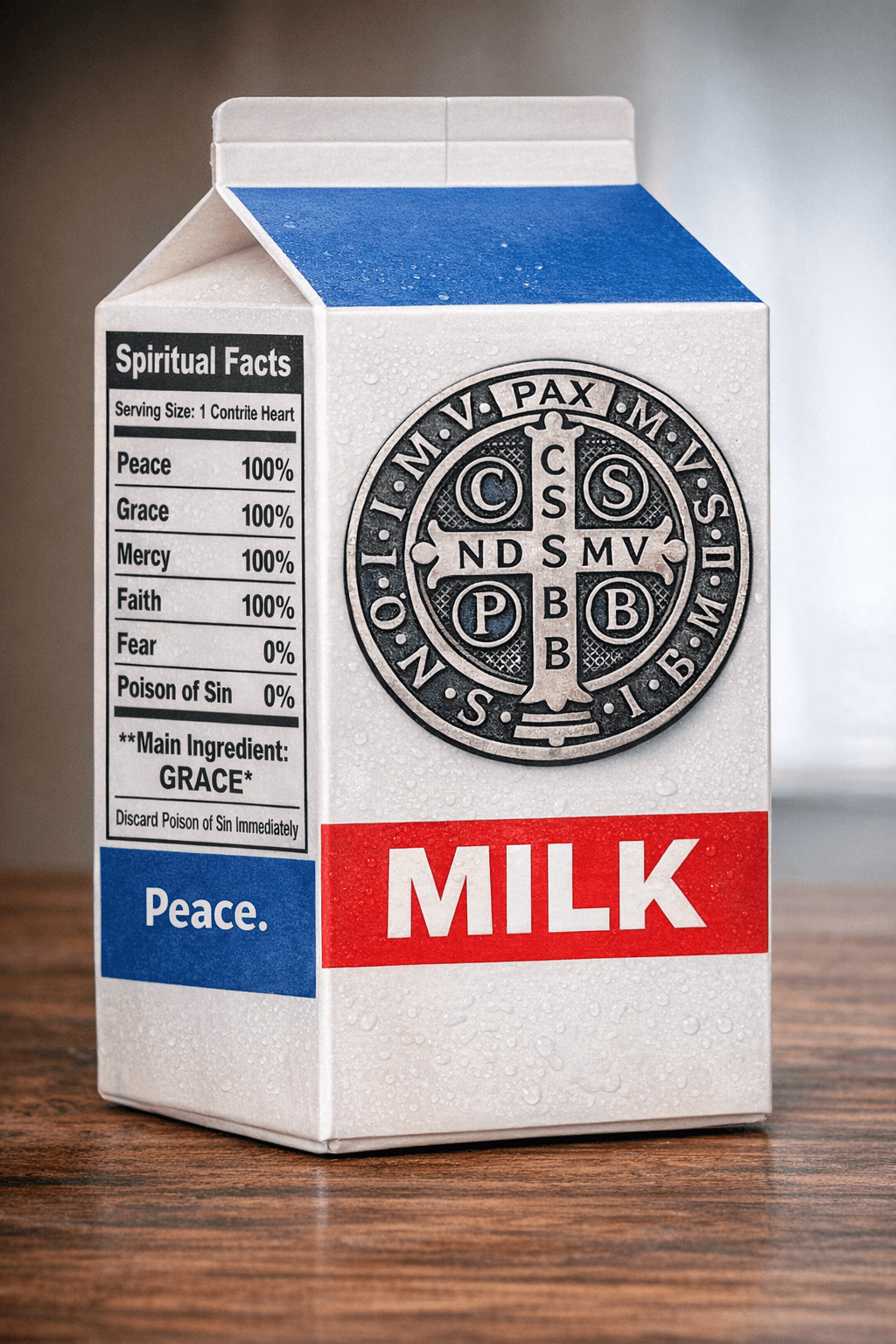
No use crying over spoiled milk, Jesus is the peace that washes the poison away.
I came home from work the other day and my son met me with a sheet of paper he had put together from a prayer he found online. It had the prayer written in English and Latin and a cool picture attached to it. Across the top he had written, “St. Benedict prayer to rid the devil.” Then my eyes moved to the lines below, and that is what stopped me in my tracks.
May the holy cross be my light!
May the dragon never be my guide!
Get away, Satan!
Never tempt me with your vanities!
What you offer me is evil;
Drink the poison yourself!
I smiled at my son, told him how much I loved what he made, and thanked him for giving it to me. After he walked away, my eyes stayed on those words. The language felt strong and direct. Nothing vague. Nothing gentle. A prayer that refuses to pretend evil sits in some neutral space.
Then something felt familiar. I had heard these words somewhere. I had seen them, but where?
Sitting there with the paper in my hand, it finally hit me. I had seen this prayer before. Not on a screen. Not in a book. On something I carried in my pocket.
I reached into my pocket and felt the familiar shape between my fingers. I turned it over and saw the same prayer, pressed into metal in tiny letters that form a cross and circle around the edge. The same strong language. The same clear naming of the battle. My St. Benedict Medal.
For years I saw this medal as something other Catholics carried. Something for “more devout” people. But temptation threads through normal routines, daily weakness, and the strain that comes with work, marriage, and family. No heart receives a free pass. Each heart holds a battleground.
Somewhere along the road, that truth sank in and I started keeping a St. Benedict Medal with me wherever I go. It sits in my pocket and, on hard days, ends up in my hand. Not as a good luck charm. Not as a replacement for confession or conversion. As a small reminder of the One who shields me and the evil he wants to keep away from my soul.
We like to picture temptation as something loud and obvious. Most of the time it does not work that way. Temptation slips in as a small offer, a small pleasure, a small compromise. A quiet suggestion at the edge of the heart, the kind of intrusion that no one else sees.
When I think about temptation, one line from this prayer pulls everything together. “Drink the poison yourself.”
I know this prayer speaks to the Evil One, but then I think about the poison, and how we get talked into taking it. Poison seldom arrives with a skull and crossbones on the label. It hides. It lies. It promises relief or comfort. It whispers, “This will help,” while peace slowly slips away. Poison works best when I agree to take that first sip.
Just one sip.
That first sip might look like a social media thread where someone starts talking down another person. A joke lands at their expense, then another one forms in your mind. Joining in feels like a shortcut to belonging to something bigger. Or it might look like a small offense you refuse to release, a careless comment replayed in your head until resentment starts to feel useful. Either way, the heart edges closer to the cup.
The more I thought about poison, the more a simple picture came to mind. Spoiled milk.
Everyone knows what happens when a carton in the fridge turns bad. The smell hits your nose, and you know. No one tries to reason with it or stretch it out. The milk goes straight down the drain. Once you know it is rotten, you do not pour a glass and pray that it might still taste good.
Temptation, once unmasked, deserves the same response. When grace allows the heart to recognize poison, the heart needs a clear no. No second look. Down the drain it goes.
That is what this old Benedictine prayer names so clearly. It does not bargain with evil. It speaks to it, and then it sends it away.
On the same side of this medal that carries those strong words, one small word stands at the top.
PAX. Peace.
That word surprised me when I noticed it again. This medal holds a strong rejection of the enemy, yet it begins with the word “Peace” at the top center of it. Peace does not grow from pretending poison does not exist. Peace grows when Christ guards the heart, when he teaches it to say no to even thinking about tasting the poison.
It is like when I pray the Our Father, and one petition has taken on greater weight for me. “And lead us not into temptation, but deliver us from evil.” Jesus places those words on our lips. He invites us to bring this struggle into prayer, to admit weakness, and to ask the Father for rescue. He wants our hearts at peace.
The prayer on the St. Benedict Medal takes that same stance and turns it into a simple daily act. A strong refusal of poison, telling the devil to drink it himself. A small medal in a pocket, carrying a quiet word of peace.
In a quiet way, this is what my son handed me with his homemade prayer card. I think he wanted to encourage his dad with strong words of faith, and he did. He also led me back to the medal I carry and to the word written across the top. A one word prayer for a single breath.
Peace.
I feel thankful that my son cared enough to search this prayer out, create his own prayer card, print it, and place it in my hand. Children watch more than adults often notice. They watch how we handle stress and disappointment. They see where we run when life hurts and when temptation knocks.
My son did not bring me a prayer rooted in fear of the devil. He brought me a prayer rooted in confidence in Christ. He reminded me that a father protects his home first by letting the Cross be his light and by surrendering his own heart to Jesus again and again.
